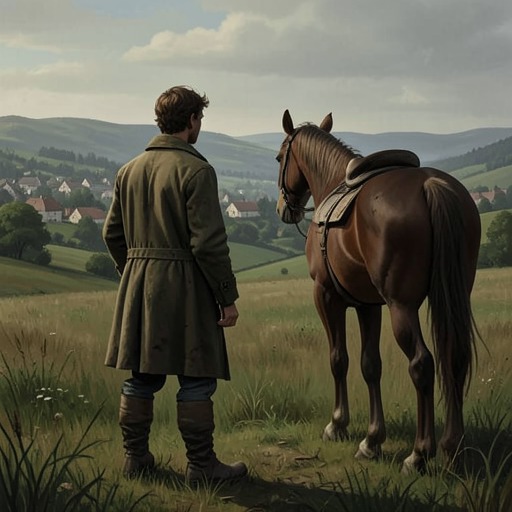
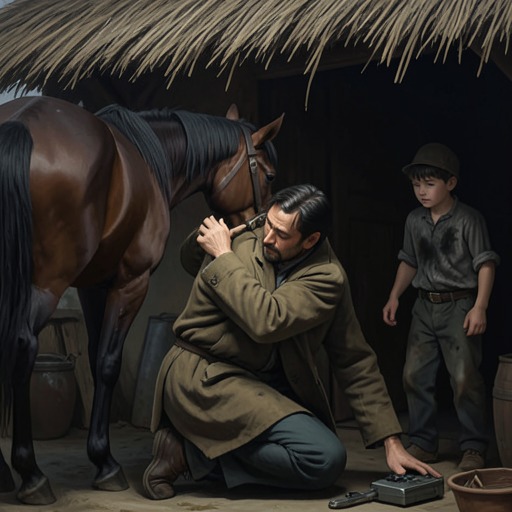
John Manly and Joe Green as Mentor and Apprentice
Black BeautyJohn Manly and Joe Green’s relationship is a practical apprenticeship shaped by patient instruction and trust. John takes on the work of training a young, inexperienced stable hand, and Joe’s growth is measured not only in the tasks he learns but in his readiness to act when horses are being cruelly treated. Their bond gives the novel a clear example of humane values passed from one generation of stable workers to the next.
The Apprenticeship Begins
When John Manly and James Howard discuss who will take James’s place, John identifies Joe Green, a boy of fourteen and a half. James doubts that someone so young and small will be useful quickly, and worries that training him will add considerably to John’s workload. John acknowledges the extra effort but agrees to try Joe for six weeks. He has argued that Joe is quick, willing, and kind-hearted, and notes that the boy wants the opportunity and that his father supports it. John’s willingness to take him on establishes the relationship as an act of confidence as well as employment: Joe is not yet an experienced worker, but John sees qualities that make instruction worthwhile.
The transition is prepared before James leaves. Joe comes to the stables to learn what he can, and James shows him the ordinary work that keeps them running: sweeping, bringing in straw and hay, cleaning harness, and helping wash the carriage. Because Joe is too short to groom Black Beauty or Ginger, James uses Merrylegs for his lessons; Joe is to have full charge of the pony under John’s supervision. This arrangement makes the limits of Joe’s youth concrete while still giving him responsibility suited to his abilities. He arrives whistling, and although Merrylegs initially resents being handled by a novice, by the end of the second week the pony thinks Joe may turn out well.
Instruction Through Trust and Responsibility
John’s teaching is gradual rather than merely verbal. Joe first learns stable duties and the care of harness and carriage, then is entrusted with more. He learns quickly and is attentive and careful enough that John begins to trust him in many matters. That trust has a practical boundary: because Joe is small for his age, he is seldom allowed to exercise Black Beauty or Ginger. John does not confuse enthusiasm with readiness; the boy’s responsibilities expand as his competence becomes evident.
The apprenticeship also takes place against the larger work of caring for horses. Black Beauty’s account describes breaking-in as teaching a horse to accept saddle and bridle, carry a rider, pull a vehicle, and obey commands, even when tired or hungry. In that world, the stable hand’s knowledge and conduct matter directly to the animal’s experience. John’s oversight of Joe’s work, including his charge of Merrylegs, therefore links technical instruction with the daily practice of attentive care. Joe’s development is shown through what he does: learning the routines, handling horses, and earning confidence through care rather than through age or size alone.
The Brick-Field Test
The clearest test of what Joe has learned comes when John is away. The master needs a note carried urgently to a gentleman’s house about three miles off, and sends Joe on Black Beauty with instructions to ride steadily. The delivery is completed, but on the return journey Joe encounters a heavily laden brick cart stuck in deep, stiff mud. Its two horses are straining without moving the wheels, while the carter pulls at the leading horse and lashes both animals. Joe stops and tells the man to stop flogging: the cart is too deeply stuck for the horses to move it by force.
Joe’s response carries the lesson beyond routine stable work. He does not ride past, nor assume that cruelty is someone else’s concern. He stays to challenge the carter and then returns to report what happened. John recognizes the importance of the intervention, affirming that it was right to act whether or not the man received a summons. His response makes the ethical dimension of the apprenticeship explicit: a stable worker’s responsibility extends beyond the horses directly in his care when he witnesses cruelty and oppression.
The episode proceeds from John’s approval to public accountability. A man has been brought before the master, who is a county magistrate, and Joe is needed as a witness. He straightens his necktie and jacket before going in, then gives evidence clearly. The horses’ exhausted condition and marks of brutal use support his account; the carter is committed to take his trial and may face two or three months in prison. Joe’s careful observation and testimony give practical force to his decision to intervene. John’s instruction has not made him merely obedient to a mentor: it has helped prepare him to exercise judgment in John’s absence.
A Change in the Apprentice
After the case, John observes that Joe seems to have grown an inch taller in a week. The remark registers a change in confidence, not a literal change established by measurement. Joe remains kind and gentle, but John sees more purpose and determination in his actions, as though he has crossed from boyhood toward manhood. The movement is significant because John’s praise follows Joe’s own choice: Joe acts first, then returns to learn that his mentor approves. Trust has become reciprocal—John has trusted Joe with responsibility, and Joe has shown that he can meet it with courage and care.
The novel later shows Joe as Black Beauty’s best and kindest groom. In his final home, the horse says that Joe treats him as a special friend, while Black Beauty’s work is easy and his strength and spirits return. This later evidence does not describe John’s presence or continued supervision, but it gives a measure of the kind of horseman Joe becomes. The early apprenticeship supplies the foundation: a small boy begins with sweeping, hay, harness, and lessons on Merrylegs; in time, his care and judgment become central to Black Beauty’s security and recovery.
Significance of the Relationship
John and Joe’s relationship joins instruction to example. John makes room for an inexperienced boy, accepts the labor of teaching him, and increases his trust as Joe proves attentive and careful. When the brick-field incident tests Joe beyond assigned stable duties, John’s approval confirms a principle that the apprenticeship has been preparing him to enact: seeing horses abused creates a responsibility to intervene. Joe’s later kindness to Black Beauty extends that principle into daily care. The relationship therefore traces not simply the transfer of a job, but the formation of a worker whose competence includes both skilled attention to horses and the resolve to defend them.